Casino Dice Game UK: Rules, Legality and Sites
 Available in GB
Understand licensing, game mechanics, payment limits and the dice formats available to players in Great Britain.

Table of Contents
- What Makes a UK Dice Casino Legal in 2026
- How Online Dice Casinos Work: RNG, RTP and House Edge
- Casino Dice Games Available to UK Players
- Dice-Themed Slots and Roll-the-Dice Games
- How to Assess the Best Dice Casino Sites in the UK
- Craps, Crypto Dice and the Limits of Alternative Casino Formats
- Bitcoin Dice Casinos and Payment Restrictions in the UK
- Where to Find Free Dice Slots and Dice Roll Games
What Makes a UK Dice Casino Legal in 2026
A legal casino dice game in Great Britain is not defined by its theme or by the type of dice mechanic used. The decisive question is whether the operator serving UK customers holds the required authorisation from the UK Gambling Commission (UKGC). Online casino games are lawful when offered by an operator with a valid UKGC licence.
The required licence
A remote operating licence is required for online gambling activities in Great Britain. Any online casino that accepts customers in this market must therefore hold a valid UKGC licence, regardless of where the business is based. This requirement applies equally to a dice casino UK site offering table-style games, digital dice products or casino games that use dice as a visual theme.
The UKGC operates within the framework of the Gambling Act 2005, the primary legislation governing gambling in Great Britain. It issues operating, personal and premises licences, although the relevant authorisation for an online casino is the remote operating licence. The regulator assesses matters including ownership, financial position, integrity, competence and criminality before granting approval.
This page highlights UKGC-licensed operators for readers exploring casino dice games in the UK in 2026. Use the listed bonus, payout-speed and minimum-deposit details as a quick starting point when reviewing your options.
License: UKGC Operator Licence · Bonus: £100 bonus · Payout speed: Within 24 hours · Min. deposit: £10 Genesis Global Limited holds a UKGC Operator Licence and lists a £100 bonus. Its stated payout speed is within 24 hours, with a £10 minimum deposit.
License: UKGC Operator Licence · Bonus: £200 welcome bonus · Payout speed: Within 48 hours · Min. deposit: £10 32Red is listed with a UKGC Operator Licence and a £200 welcome bonus. Payouts are stated as being processed within 48 hours, and the minimum deposit is £10.
License: UKGC Operator Licence · Bonus: £100 bonus · Payout speed: Within 24 hours · Min. deposit: £10 LeoVegas holds a UKGC Operator Licence and offers a £100 bonus. Its listed payout speed is within 24 hours, with a £10 minimum deposit.
License: UKGC Operator Licence · Bonus: £50 bonus · Payout speed: Within 48 hours · Min. deposit: £10 Platinum Gaming Limited is listed under a UKGC Operator Licence and provides a £50 bonus. The stated payout speed is within 48 hours, and the minimum deposit is £10.
License: UKGC Operator Licence · Bonus: £100 bonus · Payout speed: Within 24 hours · Min. deposit: £10 ProgressPlay Limited holds a UKGC Operator Licence and lists a £100 bonus. Its stated payout speed is within 24 hours, with a £10 minimum deposit.
License: UKGC Operator Licence · Bonus: £20 bonus · Payout speed: Within 48 hours · Min. deposit: £10 Silverbond Enterprises is listed with a UKGC Operator Licence and a £20 bonus. Payouts are stated as being processed within 48 hours, and the minimum deposit is £10.
A licence can be checked against the UKGC public register. The operator name or licence number should correspond with the registered domain. This distinction matters because a website may describe itself as a casino dice platform without being authorised to provide gambling services to British consumers. Unlicensed or unauthorised gambling operations are a criminal offence.
Age, identity and player access
The legal gambling age for online and land-based gambling in the UK is 18. Operators must verify that a player is at least 18 before allowing deposits or play. KYC (Know Your Customer) is mandatory for UK-licensed casinos, so identity checks form part of lawful access rather than an optional administrative step.
Players do not pay gambling tax on winnings in the UK. However, this does not remove the operator’s licensing obligations. A dice casino game, including one promoted under crypto-related terminology, remains subject to the same baseline requirement when it is offered to UK customers: the service must be provided by a UKGC-licensed operator.
How Online Dice Casinos Work: RNG, RTP and House Edge
An online casino is a website or app where casino-style games are played over the internet with real money. In an online dice casino, the result of each round is produced digitally rather than by physical dice observed at a table. The central questions are therefore how the result is generated, whether the process has been tested, and how the game’s long-run mathematics are presented.

How the RNG determines each result
Online casino game outcomes are determined by a Random Number Generator (RNG). An RNG is a complex algorithm that generates sequences of numbers designed to be statistically independent and unpredictable. The game software converts the generated output into the result displayed on screen, such as a dice value or a combination of values.
Independence matters because the result of one round does not establish the result of the next. A previous roll does not make a particular number “due”, and a recent sequence does not create a mathematical obligation for the software to compensate with a different outcome. This applies whether the game is described as an online casino dice game, a dice-themed product or another form of digital casino play.
Unpredictability is a separate property. It means that the next result cannot be reliably inferred from the visible sequence of earlier results. A player may identify patterns in a history panel, but an apparent pattern is not evidence that the RNG has changed its behaviour. The visible record describes completed rounds; it does not provide a dependable forecast of the next one.
Independent testing and certification
Before a game is offered at a UK-licensed casino, its RNG must be tested and certified by an independent testing laboratory. Testing is not limited to checking whether a particular session appears balanced. Independent laboratories test RNG integrity, verify that the game mathematics match the advertised Return to Player (RTP), and audit platform fairness.
This creates a distinction between the operator’s presentation of a game and external assessment of its underlying operation. A casino may display a dice game, its rules and its RTP, but the relevant testing process examines whether the implemented mathematics correspond to those disclosed features. The purpose is not to predict individual wins. It is to establish whether the system operates according to the specified design.
Independent testing ensures that the game mathematics match the advertised Return to Player (RTP) and that the RNG operates according to its specified design.
Consequently, fairness does not mean that every short sequence contains a representative distribution of outcomes. A fair RNG can produce clusters, repeated values or an apparently unfavourable run. Randomness is assessed across the operation of the system, not by requiring every player’s session to resemble the long-run model.
What RTP measures
Return to Player (RTP) is a statistical measure of the amount a game is designed to return over a very large number of rounds. RTP is calculated over millions of game rounds rather than individual sessions. UK-licensed casinos must display the RTP for each game, allowing the stated theoretical return to be identified before play.
A slot with 96% RTP is designed to return £96 for every £100 wagered on average over millions of spins. The remaining 4% is the house edge. This is a long-run mathematical relationship, not a promise that a particular player will receive £96 after wagering £100, nor a description of the result of one visit.
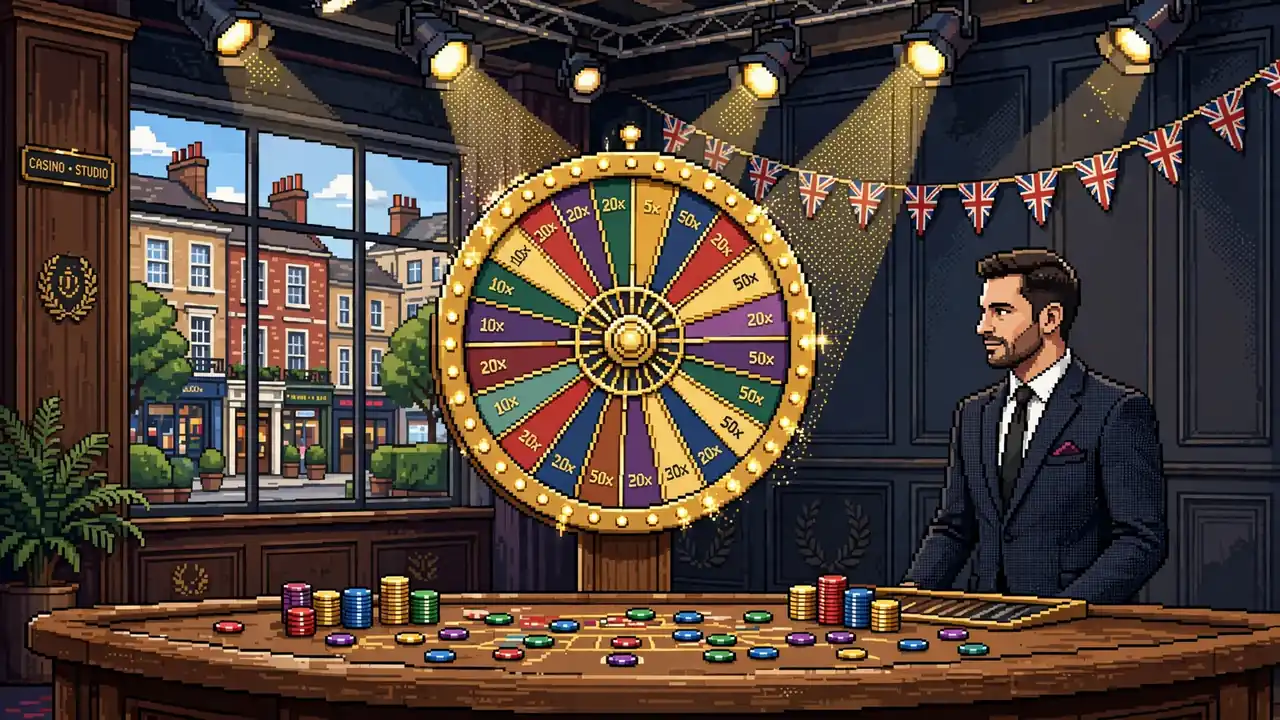
The same principle applies when comparing dice games online in a casino. An advertised RTP describes the game’s theoretical return under its stated rules. It does not indicate that a sequence of rolls will settle near that figure, and it does not determine whether a particular session ends in profit or loss. Short-term results can differ substantially from the long-run expectation.
RTP and the house edge
The house edge is the built-in mathematical advantage the casino has in a given game. It is the portion of the wager that the game is designed to retain over time, expressed through the relationship between the stake and the theoretical return. A game with a 2.7% house edge has a 97.3% RTP.
Higher RTP means a lower house edge, but it does not guarantee individual winning sessions. The relationship is useful for comparing the stated mathematics of different online casino dice games, while remaining separate from predictions about immediate outcomes. A higher theoretical return reduces the operator’s long-run advantage relative to a lower-RTP game; it does not remove that advantage.

Reading a dice game’s information
The practical mathematical distinction is between a round and a population of rounds. The RNG determines the individual outcome. Independent testing examines whether the generator and game calculations operate as specified. RTP describes the expected long-run return. The house edge expresses the corresponding operator advantage.
These concepts should not be merged. A recent result cannot demonstrate that an RNG is faulty, a winning session cannot establish a favourable RTP, and a displayed RTP cannot be treated as a personal payout rate. The same framework applies to an online dice casino UK players access through a website or app, to online casino dice games presented in other formats, and to free online casino dice games when the software is being demonstrated without real-money wagering. The presence or absence of a cash stake changes the financial context, but it does not turn a short sequence into evidence about long-run fairness.
Casino Dice Games Available to UK Players
Dice-based gambling covers several distinct formats. Some games use physical dice as the central mechanism, while others adapt dice outcomes into a broader casino structure. The shared feature is that a roll, or a simulated roll, determines the result of a wager. The rules, betting options and mathematical advantage differ substantially between games, so “dice casino games” is not a single category with one universal method of play.
Craps and traditional dice tables
Craps is the best-known dice table game. It is played with two dice and a sequence of rolls called a round. Players place wagers on possible outcomes, with different bets relating to the opening roll, later rolls or particular dice combinations. The table layout allows several bets to remain active at once, making craps more complex than a simple wager on one roll.
A complex dice table game involving multiple betting positions and sequences of rolls.
A three-dice casino game offering wagers on specific numbers, combinations, and broader outcomes.
Compact games focused on single predictions like high/low or numerical ranges.
The attraction of craps lies in its range of betting positions. A player may bet on a broad result or on a more specific combination, depending on the rules of the table. These options do not have identical mathematical properties. A narrow proposition can be less favourable than a basic line bet, even though both are settled using the same pair of dice.
Craps is therefore a dice table game rather than merely a game of guessing whether a roll will be high or low. Its terminology, betting stages and table positions form a distinct system. Online versions reproduce that structure through a digital interface, while live versions may present a dealer-led table with physical dice.
Sic Bo and three-dice casino games
Sic Bo uses three dice and offers wagers on individual numbers, combinations and broader outcomes. The range of possible results is wider than in a two-dice game, and the paytable determines how each winning combination is settled. As with other casino games involving dice, the visual simplicity of the roll does not mean that every betting option has the same value.
The game is often presented as a dedicated dice table, with the dice displayed in a tray or generated digitally. Its central mechanic is straightforward: a wager is selected, three dice are rolled, and the result is compared with the relevant betting categories. The variety comes from the number of available combinations rather than from a long sequence of rounds.
Sic Bo illustrates why the label “casino games played with dice” includes more than traditional Western table games. It is a recognised casino format with its own terminology and rules, rather than a variant of craps.


Simple dice wagers and casino adaptations
Some online casinos offer compact dice games built around a single prediction. The wager may relate to a numerical range, a high or low result, or a particular outcome. These games are less elaborate than craps and usually require fewer decisions between rolls. They can appear as standalone casino games or as part of a broader table-games catalogue.
The term “dice games at the casino” can therefore refer to both established table formats and simplified digital adaptations. The interface may show one or more dice, but the important distinction is the betting model: whether the game uses an extended table structure, several linked wagers, or one isolated prediction.
Dice-themed products should also be separated from genuine dice table games. A game may use dice imagery without making a dice roll the actual basis of the wager. That distinction matters when comparing casino games with dice, because appearance alone does not identify the underlying mechanic.
House edge across dice games
Every casino game is designed with a house edge, the built-in mathematical advantage held by the operator. It means that the casino is expected to profit over time, although it does not determine the result of an individual session. Different dice games, and different wagers within the same game, can have different mathematical profiles.
A higher Return to Player (RTP) corresponds to a lower house edge, but it does not guarantee a winning session. One stated example is a game with a 2.7% house edge and a 97.3% RTP. These figures describe long-run mathematics, not a prediction about the next roll or a particular player’s outcome.
Understanding Dice Games
- Different formats like Craps and Sic Bo have distinct mathematical properties.
- Dice-themed slots use dice imagery but operate on different mechanics than table games.
- Always verify the specific rules and betting structure of a game before playing.
For that reason, comparisons among dice casino table games should focus on the rules and the specific wager rather than on the presence of dice alone. Craps, Sic Bo and simpler dice formats may share a rolling mechanic while offering materially different betting structures and expected outcomes.
Dice-Themed Slots and Roll-the-Dice Games
Dice-themed slots occupy a distinct place within online casino catalogues. They use the imagery of dice, numbered faces, rolling animations and board-game motifs, but their underlying structure is that of a slot rather than a traditional dice table. The result is a casino game with dice in its visual identity, while the outcome is generated through the slot’s programmed reels, symbols and bonus features.
This distinction matters when comparing dice casino sites UK players may encounter. A page labelled “dice” can contain several different products: a table game in which the player selects a wager on a dice result, a slot with dice symbols, or a roll-the-dice feature embedded in a wider slot. These formats should not be treated as interchangeable. Their interfaces, payout structures and information requirements differ.


How dice slots differ from table-style games
A conventional dice game presents a limited set of outcomes linked directly to the roll. A dice slot instead uses reels or virtual displays. Dice may appear as ordinary symbols, wilds, bonus triggers or decorative elements, while the game’s mathematical model remains that of a slot. In some products, a roll is presented as a decision point or bonus event; in others, it is simply an animation accompanying a spin.
The phrase “roll-the-dice” therefore describes presentation as much as mechanics. It does not, by itself, establish that the player is making a physical-style dice wager. The relevant information is found in the game rules, including the paytable, the function of each symbol and the conditions attached to any bonus round.
This also explains why searches for UK casino sites with dice games can produce mixed results. Some results may feature casino slot dice games, while others may list craps, Sic Bo or a simple dice betting product. A comparison based only on the title or artwork risks grouping unlike games together.
Named dice-themed slot products
The following products are associated with dice or rolling themes and can be considered when reviewing a dice slots casino catalogue:
- Dice and Roll — a dice-themed slot product.
- Dice Dice Baby — a dice-themed slot product.
- Mega Moolah — a named slot product that may appear in broader casino slot catalogues, although its title alone does not establish that it is a dice game.
The available facts do not establish a provider, RTP, volatility profile or bonus structure for these individual products. Those characteristics should therefore not be inferred from their names. A catalogue entry can identify the game, but the rules screen and displayed game information are needed to determine how it operates.
What to examine in a dice slot
The central measurable feature is Return to Player (RTP). UK-licensed casinos must display the RTP for each game, allowing a dice slot to be assessed on the same formal basis as other slot products. RTP is a long-run statistical measure calculated over millions of game rounds, not a prediction for one session.
A slot with 96% RTP is designed to return £96 for every £100 wagered on average over millions of spins. The remaining 4% represents the house edge. This does not mean that every sequence of spins will produce a return close to that figure. Individual results can differ substantially, and RTP does not guarantee a winning session.
The presentation of dice does not alter this principle. A visually prominent roll, multiplier or collection feature may make the game feel more interactive, but the long-run mathematical expectation remains determined by the game’s certified design. The relevant comparison is consequently the published RTP and the stated rules, not the animation or theme.
Other information deserves equal attention:
- the paytable and symbol values;
- the role of dice symbols in winning combinations;
- whether a roll triggers a bonus feature;
- the rules governing any free-spin or feature round;
- the displayed RTP;
- any maximum win or stake conditions stated in the game information.
The facts available here do not establish particular maximum wins, stake limits or feature conditions for Dice and Roll, Dice Dice Baby or Mega Moolah. Such details should not be supplied by analogy with another slot.
Promotions attached to dice slots
Promotional terms can change the practical cost of playing a dice slot. Casinos must clearly state the terms and conditions of promotions, and bonus offers may impose wagering requirements, maximum bet limits, game restrictions, expiry periods and maximum withdrawal caps. A dice slot may also be excluded from a promotion or contribute differently from another game, so the game’s inclusion must be confirmed in the offer terms.
One profile review describes a possible UK casino welcome offer as a 100% deposit match with 50 free spins on a dice slot and wagering requirements of around 35 times the bonus amount. That description is an example from a single source, not an established market standard. It should not be treated as a general feature of dice casino sites.
Important Note Wagering requirements on bonuses are not universal; always check the specific operator’s terms as they can vary significantly.
A separate source states that wagering requirements on bonuses are capped at 10 times. Because the supplied evidence attributes this point to one source, it should be presented as a source-specific claim rather than as a universal rule for every UK casino promotion. The binding terms remain those published by the relevant operator, subject to the applicable regulatory framework.
Dice visuals and game classification
The same theme can appear across different products. A slot may use a single die as a wild symbol, several dice as part of a bonus round, or a rolling animation between spins. None of these features is sufficient to classify the product as a traditional dice table. The classification depends on the game’s actual rules and outcome structure.
This is particularly relevant to terms such as “dice slots games”, “casino dice slots” and “slots dice game”. In natural usage, these expressions can refer to any slot with dice imagery. A precise description should identify whether the product is reel-based, feature-based or a direct dice wager. That distinction prevents a themed slot from being presented as a separate form of table gambling.
Dice slots may appeal to players seeking a familiar visual connection with dice without the rules of craps or Sic Bo. Yet the theme does not remove the house edge, and it does not make the outcome more controllable. The published RTP remains the appropriate long-run measure, while the game rules determine how each spin and feature operates.
How to Assess the Best Dice Casino Sites in the UK
A meaningful comparison of dice casinos UK players can access should begin with evidence, not branding. The relevant question is not which site uses the most prominent dice imagery, but whether the operator can demonstrate lawful access, fair-game controls, transparent promotion terms and effective safer-gambling measures. These criteria apply equally to a casino centred on dice games and to a broader online casino that includes dice-themed products.
- Verify the operator’s UKGC licence via the public register.
- Check the stated RTP for each game before playing.
- Use tools like GAMSTOP for safer gambling.
- Rely on dice imagery alone to identify a game’s mechanics.
- Assume a high bonus value translates to easy winnings without checking wagering terms.
- Treat free play modes as a guarantee of real-money performance.
1. Confirm the operator’s UKGC status
The first screening step is verification of the operator’s UK Gambling Commission position. A casino serving consumers in Great Britain must hold a remote operating licence, regardless of where the business is incorporated. The UKGC maintains a public register of current operating and personal licences, making the register the appropriate reference point rather than a logo displayed on a casino website.
The operator’s legal name or licence number should correspond with the register. The listed domain should also match the website being assessed. This matters because an authorised business may operate more than one brand, while an unrelated website may use similar design, wording or licensing claims. A licence reference without a matching domain does not establish that the particular site is covered.
A practical comparison record can therefore include:
- the operator’s legal name;
- the remote operating licence reference;
- the domain shown in the UKGC register;
- the availability of KYC before deposits or play;
- clear information about complaints and account restrictions.
KYC is not an optional quality feature at UK-licensed online dice casinos. Operators must verify that players are aged 18 or older before allowing deposits or play, and they must monitor transactions for clear signs of gambling harm. A site that treats identity verification as an unexpected obstacle, or that gives contradictory explanations of when checks occur, warrants closer scrutiny.
2. Examine fairness information rather than visual presentation
The appearance of a dice casino says little about the reliability of its games. Relevant information concerns the game’s RNG, independent testing and Return to Player (RTP). At a UK-licensed casino, the RNG must be tested and certified by an independent testing laboratory before the game is offered. Testing laboratories assess RNG integrity, check that the mathematics correspond with the advertised RTP and audit platform fairness.
The game information should therefore be accessible before play. UK-licensed casinos must display the RTP for each game. That figure describes a long-run mathematical expectation across millions of rounds, not the result of an individual session. A higher RTP corresponds to a lower house edge, but it does not guarantee a winning outcome for a particular player or sequence of rolls.
Comparison should focus on whether the information is specific and internally consistent:
- Is the RTP stated for the individual game?
- Is the game provider identified?
- Is the random outcome mechanism explained?
- Are rules and winning conditions available before the wager?
- Does the help material distinguish long-run RTP from a personal return?
A site that makes general claims about “fair dice” without identifying the relevant game information provides less evidence than one that presents the technical details in a clear, inspectable form. The same principle applies to promotional claims about high payouts: they do not replace the disclosure of RTP or the game rules.
3. Treat bonuses as contractual terms
Welcome Bonuses can make two otherwise similar online dice casinos appear different, but the headline offer is only one part of the assessment. The material terms determine whether the bonus is usable and whether winnings can be withdrawn. Those terms should state the wagering requirements, eligible games, contribution rules, maximum bet limits, expiry periods and any maximum withdrawal caps.
A profile review reports that a welcome bonus might require the bonus amount to be wagered 20 to 40 times before withdrawal. That range should be treated as an example of how demanding terms may be presented in industry material, not as a universal condition applying to every UK operator. The casino’s own published terms remain decisive for the specific offer.
Understanding Wagering Requirements
To calculate the actual effort required for a bonus, multiply the bonus amount by the wagering requirement. For example, a £10 bonus with a 40x requirement necessitates £400 in total wagering.
The arithmetic should also be read carefully. A £10 bonus subject to a 40x wagering requirement would require £400 in wagering before the bonus could be converted into cash. This illustrates why the nominal bonus value cannot be assessed independently of its multiplier. Since January 2026, wagering requirements have been capped at a maximum of 10x, according to the stated market information; any offer presented with a higher multiplier requires particular scrutiny against the applicable terms and regulatory position.
The comparison should record the following details in one place:
- Whether the requirement applies to the bonus, the deposit, or both.
- Which dice games count towards completion.
- Whether dice-themed slots receive a different contribution from table-style games.
- The maximum stake permitted while the bonus is active.
- The deadline for completing the requirement.
- What happens to bonus funds and associated winnings after expiry.
- Whether a maximum withdrawal condition applies.
Terms that are difficult to locate, written inconsistently across the promotion page and full conditions, or presented only after registration reduce the evidential value of the offer. A lower headline bonus with complete terms may be more assessable than a larger claim whose restrictions are unclear.
4. Separate promotional value from cash balance
Bonus accounting can obscure the actual financial position of an account. A site should distinguish deposited funds, bonus funds, restricted winnings and withdrawable cash. The terms should explain whether depositing activates an offer automatically, whether accepting it changes the rules for later withdrawals, and whether cancelling the bonus affects associated winnings.
A comparison of the best online dice casinos should not treat free spins, deposit matches or cashback bonuses as equivalent benefits. Each has different conditions, and the relevant measure is the applicable wagering requirement and game eligibility rather than the promotional label. The same caution applies to claims that a particular offer is exclusive, limited or unusually generous: without complete conditions, those descriptions have little analytical value.
Effective safer-gambling measures include accessible deposit limits, clear self-exclusion instructions, and active monitoring for signs of gambling harm.
5. Assess safer-gambling controls as operating features
Safer-gambling tools should be evaluated alongside licensing and game information, not added as a decorative final paragraph. UK-licensed operators must participate in GAMSTOP. The service can exclude a player from all UKGC-licensed gambling sites for six months, one year or five years. A casino that does not explain its participation, or that presents self-exclusion as an informal customer-service request, provides an incomplete account of its controls.
Operators must also prompt new customers to set a financial limit before the first deposit. This requirement should be visible during account opening rather than buried in general account settings. A profile review additionally states that financial vulnerability checks apply when net deposits exceed £150 in a rolling 30-day period. Because this threshold is reported by a single specialist review, it should not be presented as a universal market rule; it is better treated as a specific point requiring confirmation in the operator’s current responsible-gambling information.
Other relevant indicators include:
- accessible deposit and loss controls;
- clear self-exclusion instructions;
- information about GAMSTOP;
- account monitoring and intervention where clear signs of gambling harm appear;
- responsible-gambling messages in affiliate advertising;
- no suggestion that continued play can recover losses.
These controls do not predict game results. Their purpose is to limit exposure and identify risk, so their practical visibility and ease of use are more relevant than the number of responsible-gambling slogans on a page.
6. Use a consistent comparison record
The strongest assessment of UK dice casinos uses the same evidence categories for every operator. A simple record can contain four sections: licence verification, fairness disclosure, promotion terms and safer-gambling controls. Missing information should be recorded as missing rather than inferred from reputation, design or user reviews.
A concise assessment framework is:
| Criterion | Evidence to record |
|---|---|
| Authorisation | UKGC register entry, operator identity and listed domain |
| Game integrity | RNG information, independent testing reference and game-specific RTP |
| Promotion terms | Wagering requirements, eligible games, maximum bet, expiry and withdrawal conditions |
| Player protection | GAMSTOP participation, financial-limit prompt, KYC and harm-monitoring information |
This method avoids confusing popularity with suitability. “Top dice casinos” is not a regulatory category, and no ranking can replace verification of the individual operator and offer. The relevant distinction is between information that can be checked and advertising language that merely creates an impression.
For online dice casinos UK users may consider in 2026, the most defensible shortlist is therefore built from documented compliance, transparent game data, readable promotional conditions and functioning player-protection tools. Where any of those elements cannot be established, the site should remain unclassified rather than being described as one of the best dice casinos UK players can safely compare.
Craps, Crypto Dice and the Limits of Alternative Casino Formats
Craps is a defined casino dice game rather than a general label for every dice-based product. A craps casino game uses dice within a structured table format, with outcomes and betting options governed by the rules of that game. The phrases “casino craps dice” and “craps dice casino” therefore describe a particular format, not a separate legal category. The same distinction applies to searches for a casino dice game called craps: the game name does not establish anything about the operator providing it.

For UK players, legality depends on the service provider rather than on whether the product is called craps, dice, or a specialised table game. Any online casino offering services to UK customers must hold a valid UK Gambling Commission licence. A game label cannot replace that requirement, and an attractive “top dice casino” ranking cannot demonstrate that a listed operator is authorised. The relevant question is whether the casino serving the UK market is licensed, not whether the game is popular or presented through a polished interface.
Crypto dice and regulatory uncertainty
“Crypto dice casino”, “dice crypto casino” and “crypto casino dice” generally refer to dice products associated with cryptocurrency deposits, balances or withdrawals. These terms describe a payment or branding model, not a distinct form of game fairness or UK authorisation. The presence of crypto terminology does not itself show that a casino may lawfully offer remote gambling to customers in Great Britain.
The central limitation is that a crypto-focused presentation does not remove the operator’s obligations. A dice site serving UK customers still falls within the requirement for a valid UKGC licence. Without that licence, the format cannot be treated as a lawful UK casino merely because it uses a different asset or calls itself decentralised.
Craps and crypto dice also share the same mathematical boundary as other casino formats: every casino game is designed with a house edge, the built-in advantage that allows the operator to profit over time. A different interface, payment asset or game name does not eliminate that structural disadvantage. Consequently, comparisons of top dice casino sites UK should separate the advertised format from the conditions under which the operator is permitted to provide it.
Regulatory Risk
Using unlicensed crypto-focused platforms to bypass UK regulations is a criminal offence and offers no legal protection for players.
Bitcoin Dice Casinos and Payment Restrictions in the UK
Bitcoin dice casinos combine two separate questions: the game format and the operator’s legal status. Bitcoin terminology does not create a separate UK gambling licence. An online casino offering dice games to customers in Great Britain must hold a valid UK Gambling Commission licence, whether its site presents the product as a bitcoin dice casino, a casino bitcoin dice platform, or a conventional casino with digital-asset references.
The relevant distinction is therefore between branding and authorisation. A Sic Bo casino, including a Sic Bo casino serving UK customers, remains an online gambling service subject to the same licensing requirement. The label Sic Bo dice game describes the game, not the operator’s regulatory position. Licence status can be checked against the UK Gambling Commission’s public register, including the operator name or licence number and the domain listed there.
Payment compliance is a separate practical boundary. The UK Gambling Commission banned the use of credit cards for gambling transactions in April 2020, and licensed operators must block credit-card deposits. Consequently, a bitcoin casino dice offer cannot be treated as a way around UK payment controls. The payment method and its processing arrangements still need to comply with the requirements applying to licensed gambling services.
Promotional language also requires careful reading. A dice casino bonus may be advertised alongside bitcoin or Sic Bo terminology, but the promotion remains subject to the operator’s stated terms. No assumption follows from the currency label that a bonus is available, withdrawable, or exempt from ordinary compliance controls.

UK players pay no gambling tax on winnings. That tax treatment does not make an unlicensed bitcoin dice casino lawful, nor does it replace the operator’s obligation to hold a UKGC licence when serving customers in Great Britain. The decisive test is authorisation to provide the online gambling service, not whether the site uses pounds, bitcoin, or another payment label.
Where to Find Free Dice Slots and Dice Roll Games
Free play is useful for separating a game’s presentation from its financial consequences. Dice-themed slots, roll-the-dice titles and casino games involving thrown dice may appear on casino websites or in mobile casino applications. A demonstration mode can show the interface, symbols and basic sequence of play without turning the session into a real-money transaction. Availability depends on the individual platform and the game catalogue it carries.
The distinction between a free demonstration and real-money gambling is material. Online casinos are websites or apps where users play casino-style games over the internet using real money. A free version therefore should not be treated as evidence that a real-money version is available, licensed, or offered under identical conditions. It is also not a substitute for checking the status of the operator before depositing or playing for money.
What free dice games can show
A free dice slot may reproduce the visual theme of rolling or throwing dice while retaining the structure of a slot. Other titles may present a casino game where dice are rolled as the central event, including formats based on three dice. These labels describe the appearance or interaction, not necessarily the mathematical category of the product.
Demonstration play can help identify:
- the basic sequence of a roll or spin;
- how dice symbols are displayed;
- whether the title behaves like a slot or a table-style game;
- the presence of bonus features or additional screens.
It does not establish likely winnings. Real-money outcomes are determined by a Random Number Generator, and each result remains separate from what occurred during free play. A favourable demonstration sequence cannot predict a later paid session.
Checking the transition to paid play
Before moving from a free mode to real-money play, the relevant game information should be available on the operator’s platform, including the displayed Return to Player (RTP). A higher RTP means a lower house edge, but it does not guarantee an individual winning session. Free dice slots and dice roll games can therefore be treated as demonstrations of format and interface, not as forecasts of performance or evidence of profitability.
What is the best dice casino game for UK players?
The best choice is a dice game offered by a UKGC-licensed casino with independently tested RNGs and a clearly displayed RTP. A higher RTP means a lower house edge, but it does not guarantee an individual win.
Are online dice casinos legal in the UK?
Yes, online dice casinos are legal when the operator holds a valid UK Gambling Commission remote operating licence. You can check the operator and its domain against the UKGC public register.
Do I pay tax on my gambling winnings?
No, players in the UK do not pay gambling tax on their winnings.
What is a Random Number Generator (RNG)?
An RNG is an algorithm that produces statistically independent and unpredictable results for online casino games. Its integrity must be tested and certified by an independent laboratory before a game is offered by a UK-licensed casino.
Created by the ”Casinouk Bonuses Guide” editorial team.